Social Anxiety in Teens: What Parents Need to Understand
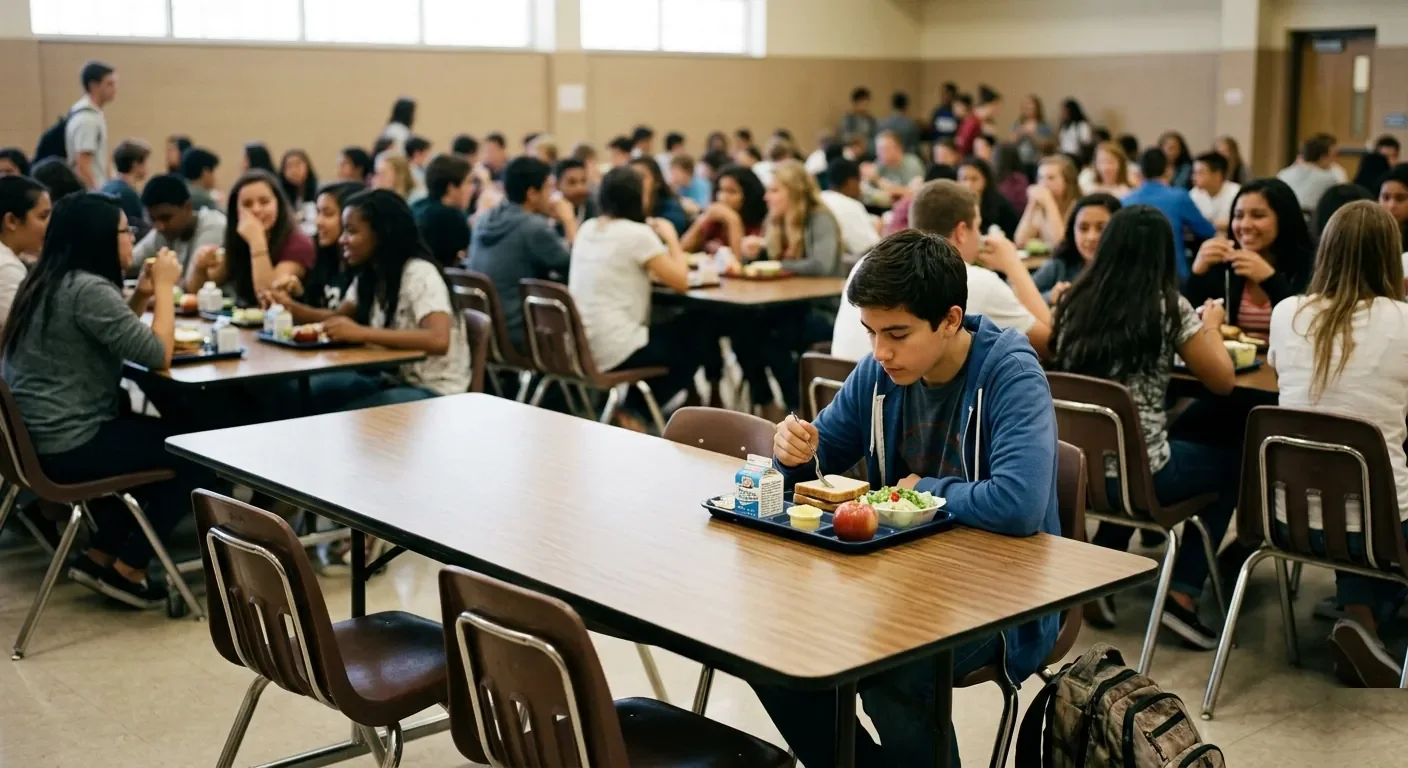
You remember who they used to be. The child who ran into birthday parties without hesitating, who raised their hand in class, who came home and told you everything. Somewhere in middle school, that child disappeared. Now your teenager eats lunch alone, turns down every invitation, treats a crowded hallway as something to be survived.
You have tried reassurance: "You'll be fine once you get there." You have tried the line every parent reaches for: "Just be yourself." Nothing lands. You are watching your teenager's world get smaller, and the hardest part is not the avoidance itself. It is that nothing you say seems to reach the part of them that is pulling away.
I'm Dr. Navvab Tadjvar, a clinical psychologist in Beverly Hills who works with adolescents and adults through psychoanalytic psychotherapy. Parents come to me describing the same thing: a child who was socially comfortable for years and then, almost overnight, began pulling away. The question underneath is always the same: what happened to my kid?
What I have found, again and again, is that social anxiety in adolescence is not about lacking confidence or social skills. It is about what it means to be visible when you do not yet know who you are.
Why Social Anxiety Starts in Adolescence
Adolescence transforms social life from something easy into something that matters. Research on adolescent development shows that roughly 75% of social anxiety cases begin by mid-adolescence, with a median onset age of 13. This is not a coincidence. The brain is becoming more sensitive to social evaluation at the exact moment when peer relationships become central to a teenager's sense of who they are.
In childhood, social interactions are relatively low-stakes. A child can move through groups without much self-consciousness because they are not yet looking to peers as a mirror for their identity. In adolescence, that changes. Every conversation, every group, every classroom becomes a place where the teenager is trying to see themselves through the eyes of others. But the image is not yet stable. They are forming an identity while being watched by the very people whose opinions now matter most. For some teenagers, this produces manageable self-consciousness. For others, it produces something closer to dread.
Avoidance builds on itself. Each situation your teenager skips makes the next one harder to face, because the social confidence that develops through ordinary interaction stops developing. The gap between your teenager and their peers, which started as a feeling, begins to become real.
Social anxiety in teens is not the same as shyness or introversion. A shy teenager prefers quieter settings but is comfortable in their own skin. Introversion feels calm and workable. Social anxiety is different: being seen by others feels exposing, as if the teenager is at risk of being revealed as not enough. The discomfort is not a preference for solitude. It is a deeper tension tied to what visibility threatens.
Being Seen Before You Know Who You Are
Adolescence produces what psychologists call the "imaginary audience": the experience of feeling constantly watched and judged, as if performing on a stage with no exit. For most teenagers, this fades as identity solidifies. For the socially anxious teenager, it does not fade. It intensifies.
In my work with these teens, they do not just worry about being judged poorly. They worry about being seen at all, because what might be revealed feels incoherent, incomplete, or not yet real.
A 2025 study on identity formation and social anxiety found that teenagers with high social anxiety struggle to form a cohesive identity because the anxiety cuts them off from the peer interactions through which identity takes shape.
This is the paradox at the center of adolescent social anxiety: the teenager needs peer relationships to develop a stable identity, but they cannot tolerate being seen by peers because that identity has not yet formed. They are not paralyzed. They are working harder than anyone in the room, constructing a version of themselves to present and monitoring every interaction for signs the construction is failing. The avoidance a parent sees is not passivity. It is the teenager deciding that the safest move is to stop performing altogether.
This is also why "just be yourself" is the worst possible advice. "Be yourself" is precisely what they cannot do, not because they are hiding, but because the self it asks them to produce does not yet feel real. The advice does not just fail to help. It makes the teenager feel like they are failing at something that is supposed to be easy, adding shame about the anxiety to the anxiety itself.
When the Body Gives You Away
The anxiety is not only psychological. Research on somatic symptoms in anxious youth found that 51% experience blushing, 45% sweating, and 43% trembling. For the socially anxious teenager, blushing carries particular weight. Darwin called blushing "the most peculiar and most human of all expressions," and for the socially anxious teenager, it is the ultimate betrayal: the body announcing the very thing they are trying to hide.
In my office, I see how quickly this becomes a second layer of fear. The teenager is not only afraid of being seen. They are afraid that their body will confirm what they already suspect about themselves: that they are not solid, not together, not someone who belongs. The flush spreading across their face feels like proof, visible to everyone, of the very incoherence they are trying to hide. This creates a loop that tightens with each episode: the fear of visibility makes the body react, and the body's reaction makes them more visible. Over time, the teenager begins to fear not just social situations but their own body's willingness to betray them. When you see your teenager's face flush at dinner and they leave the table, this is the loop at work.
Social Anxiety in Teens on the Westside of Los Angeles
I work with teenagers on the Westside of Los Angeles, and social anxiety here carries a particular weight. The environment is built for comparison. Academic performance is tracked and discussed openly. Social hierarchies at school are rigid and visible, and social media makes the evaluation continuous. The teenager is being measured not just in the hallway but on their phone, not just during school hours but at night, in their bedroom, scrolling through evidence of everyone else's ease.
What I hear in my office is not just "do they like me?" but something closer to "how do I rank? Where do I stand? Am I falling behind?" Teens talk about who is popular, attractive, well-connected, or successful, and the fear is not of catastrophic humiliation but of small social missteps: saying the wrong thing, laughing at the wrong time, being visibly uncertain in a room that rewards ease. The Westside amplifies this paradox because the standard is not just competence but the appearance that competence comes naturally. For a socially anxious teenager, this doubles the performance. They are not only managing how they come across. They are managing how much effort it looks like they are spending to come across that way. If your teenager comes home from school drained and silent, this is part of the reason.
Why Exposure Therapy Is Not Enough
If you have started looking into help for your teenager, you have likely encountered exposure therapy. It is the most commonly recommended treatment for social anxiety in teens, and the logic is straightforward: the teenager fears social situations, so you gradually expose them to those situations in controlled steps until the fear lessens.
But exposure therapy rests on an assumption: that the fear is irrational, and that proving "nothing bad happens" will teach the teenager's nervous system to stand down. For many anxiety disorders, this assumption holds. For adolescent social anxiety rooted in this developmental paradox, it often does not.
If a teenager is terrified of being seen because they do not yet have a stable self to show, that fear is not irrational. It is developmental. You cannot expose your way through an identity crisis. Showing a teenager that "nothing bad happens" when they speak up in class does not address the question underneath: who am I, and will I hold together if someone looks closely? Social life still feels like a test they are constantly at risk of failing. Exposure can teach them to pass the test. It does not change the fact that every interaction feels like one.
And there is a further risk. When exposure is applied to a teenager caught in this pattern, it can deepen the very pattern it is trying to break. The teenager learns to survive the situation, not to feel less afraid. They add "getting through the exposure" to the list of performances they are managing. The self-monitoring does not decrease. It expands to include therapy itself.
How Psychoanalytic Therapy Helps Social Anxiety
Psychoanalytic therapy does not start by asking the teenager to face the situations that feel threatening. It starts by inviting them to speak freely to whatever comes to mind. If your teenager barely talks to you right now, they may not talk much at first in therapy either. That is expected. The work does not depend on the teenager narrating their experience fluently. The themes of judgment, evaluation, and pressure to perform do not have to be assigned as topics. They emerge on their own, in real time, within the therapeutic relationship itself. The anxiety is not just reported. It is present in the room: in what the teenager edits before saying, in the silences, in how they watch my face for signs they have said the wrong thing.
What matters most in those early sessions is that the teenager experiences a relationship where they do not have to manage how they come across, where they can speak awkwardly or uncertainly without performing competence. I am listening for where the pressure shows up, what feels most exposing, how they talk to themselves in those moments, and I am helping them put words to experiences that have mostly been felt as tension or fear. For many of these teenagers, this is the first time the anxiety has become something they can understand together with another person, rather than something they have to hide or fight on their own. That shift, from isolation to shared understanding, is where the work begins.
What Changes When a Teenager Stops Performing
The change is not dramatic. There is no moment where the anxious teenager becomes confident and outgoing.
In the room, I notice it first in how they talk. The rigid self-monitoring softens. They stop editing every sentence before it leaves their mouth. They say something and look surprised that they said it, as if they did not expect to be that honest. They describe a social moment without catastrophizing it, or they laugh about something that would have consumed them a month earlier.
At home, parents notice different things. Their teenager mentions a conversation they had at school. Not a dramatic one, just a mention. They accept an invitation they would have refused. They recover from an awkward moment without it consuming the rest of the evening. They begin to tolerate ordinary social uncertainty, the not-knowing how things will go, without needing to control or avoid it. The world gets a little larger.
What makes this possible is neither insight nor courage. It is the accumulated experience of a relationship where being seen did not carry a cost. Week after week, the teenager has been visible in the therapy room without being evaluated, without having to perform, without the interaction becoming a test. That experience, repeated enough times, loosens the equation that has governed their social life: that visibility equals threat. They no longer feel as defined by how they might come across. There is more room to be imperfect, more room to simply be.
Social anxiety is one expression of the broader passage of adolescence. I have written about what teenage angst communicates and about how anger does similar protective work during this same developmental period.
Frequently Asked Questions About Social Anxiety in Teens
When should I seek professional help for my teenager's social anxiety?
If your teenager's avoidance is shrinking their world, that is worth paying attention to. Turning down one party is not cause for alarm. But when a teenager stops seeing friends, dreads school, or structures their life around avoiding situations where they might be noticed, the pattern has moved beyond ordinary shyness. Early support makes a difference because adolescence is also a window of neuroplasticity where therapeutic work can take hold.
How long does therapy for social anxiety in teens typically take?
There is no fixed timeline. Some teenagers feel relief in the first weeks as the pressure of constant self-monitoring begins to ease. Deeper shifts in how they experience themselves around others take longer, often several months of consistent work. Progress tends to show up at home before the teenager can name it themselves: accepting an invitation, mentioning a friend, recovering from an awkward moment without spiraling.
What can I do at home to support my socially anxious teenager?
Resist the urge to reassure. "You'll be fine" and "just be yourself" are well-meaning but tend to make the teenager feel more alone with their experience, not less. What helps more is naming what you see without trying to fix it: "I notice you've been turning down plans. I'm not going to push, but I'm here." The goal is not to solve the anxiety. It is to let your teenager know they are seen without being evaluated.
Can social anxiety in teens go away on its own?
Sometimes mild social anxiety eases as a teenager matures and their identity stabilizes. But for many adolescents, avoidance becomes self-reinforcing: the less they engage socially, the harder it becomes to start again, and the more their world narrows. Without intervention, social anxiety that begins in adolescence often persists into adulthood. Waiting to see if it passes can mean losing the developmental window where change comes most naturally.
Does social media make social anxiety in teens worse?
Social media does not cause social anxiety, but it amplifies the conditions that feed it. The comparison is constant, curated, and inescapable. A teenager who already feels watched now has evidence, in the form of likes, followers, and stories, of exactly where they stand relative to their peers. The performance never stops, and the audience never leaves. For a teenager already struggling with visibility, social media removes the last spaces where they might have felt unseen.
Is my teenager's social anxiety my fault?
No. Social anxiety emerges from a collision of developmental timing, temperament, and environment. It is not caused by something you did or failed to do. But parents often carry guilt about it, and that guilt can show up as over-reassurance or frustrated pushing, both of which tend to intensify the cycle. The most useful thing a parent can do is understand what the anxiety is about, not blame themselves for its existence.
Your teenager's world does not have to keep getting smaller. Social anxiety in adolescence is not a sign that something is broken. It is a signal that the work of becoming visible, of forming an identity in the presence of others, needs support that reassurance alone cannot provide.
If your teenager is disappearing from social life and nothing you say is reaching them, I work with adolescents in Beverly Hills and throughout California to help them find not confidence, but something more fundamental: a self that feels solid enough to be seen.
